Saturday, March 19, 2016

1. Explain why you selected the video you choose from the selection listed above.
  • Was required
  • I like learning about early art and how we use past methods today.  We develop pieces by looking at past art and advancing.  Also like learning about Greek art/culture because they have Gods and Goddesses.  

2. For each video list/discuss the key concepts you learned.
More Human Than Human:
  • Seagull study
  • Create things based off of our culture
  • Numerous works of 'Venus' around the world, all very much similar
  • Humans obsess over bodies but don't necessarily have realistic visions of it
  • Why do we create unrealistic but realistic things? (no arms, by other limbs)
  • Why do we emphasize some things more than others? (no face, large breasts)
  • Culture

The Greek awakening: Art from the 5th Century BC
  • Restoring of sculptures
  • Humanism, rationalism
  • Human in the center of existence 
  • Columns
  • Pollution affects the sculptures, must be reserved
  • The theater still used to this day


3. How do the videos relate to the readings in the text?
These videos go over topics discussed in the text but just add further depth to them.  There are many different images provided to help give use a deeper connection about what is being talked about in some sections of the text.  The repetition of pictures in the text and also in the videos.  
4. What is your opinion of the films? How do they add depth to understanding of the readings and art concepts?
I enjoyed the films and I like being able to pick films that interest us.  Given this option I think it's easier to grab more from the film and easier to pay attention to the detail.  These films were very educational and helped elaborate on ideas discussed in the text in more detail while providing us with more information.  

Monday, March 7, 2016

1. For each video list/discuss the key concepts you learned.
Prairie Style:
  • Laying of horizontals
  • House should represent time, place and client
  • "organic"- part of the landscape/nature
  • harmony with nature
  • open floor plan
  • good unity between nature, furniture, detail, exterior and interior

Architecture: The Science of Design:
  • Foundation
  • Sensors in houses to minimize electricity use
  • Concrete
  • Must consider dead weight/ weight with people
  • Pre-stressed concrete
  • Reinforced concrete

2. How do the videos relate to the readings in the text?
In the text, we read about Frank Lloyd Wright and his trade mark 'prairie houses".  We learn about his way of doing things and are given some examples as to why so many critics believe that he is the greatest American architect of his time.  Also, in the text we learn about reinforced concrete which is mentioned in the second video I watched.  
3. What is your opinion of the films? How do they add depth to understanding of Architecture?
I think the films add more depth to topics we have read in the text because sometimes having more of a visual is more useful when it comes to understanding.  I think watching the videos instead of just looking at the pictures and having someone else talk about it makes it easier to understand.  Being able to see examples of prairie houses in the film made me realize what exactly Frank Lloyd Wright did and how they turned out.  Also watching how the reinforced concrete worked in the film made me understand the concept better.  
4. Why did you choose the films that you watched?
I decided to chose the Prairie style video because I like the architecture of it.  I like how nature was always incorporated with the house and was respected.  I also enjoy houses where he used windows to kinda break the barrier of inside outside.  Ceiling to floor windows are something i'd like to have in my house.  I decided to watch the second video because I was interested in learning more about how we build skyscrapers and other buildings.  I was also interested in learning about the sensors that people can have in their households.  

Sunday, March 6, 2016

First, I looked at http://blogbyart2016.blogspot.com/, I liked the pictures she chose to show her elements and principles.  With both blogs I looked at it was interesting to see that one or more element/principle could be found in an object/ work of art.  I also found this out while I was taking my pictures.  I also looked at http://funart2825.blogspot.com/, she also chose daily objects to use to show her elements/ principles.  I liked how both of these blogs chose different ways to show elements/ principles. 

In project #2 none od our images were the same which was awesome because I got to look at more art that I may have not noticed while at the gallery.  Looking at the pieces shown was interesting though because after reading their response to the art I could agree with their comments.  Both of their pieces showed a lot of mystery and made me question the reason behind them.  It's interesting looking at what someone else is interested in and their opinions towards it and seeing how I can relate. 
 There were two that I personally enjoyed a lot; Reckless and Marquette for loom and see.  Reckless was abstract and actually done of the floor which was very unique and something I have never seen before. Marquette for loom and see was a sculpture outside that was very interesting and made me wonder a lot.  I want to know the reasons for creating such unique piece and how the artists got their ideas to create such abstract pieces.  

I think it's valuable to see others opinions and interests. It makes us see things that we may have looked over or not thought of.  I think seeing peoples comments on my work and looking at others; they were very helpful.  Also it helps us see who we might share common interest with art wise.  

Wednesday, March 2, 2016

1. For each video list/discuss the key concepts you learned.
Through the Eyes of a Sculptor:
  • The dangers of the job
  • How some craftsmen would focus/work on just one part of the sculpture, some had specialized jobs 
  • Marble quarries
  • How weather effects the materials

Glass and Ceramics:
  • Ceramics used in computers
  • Ceramic used for medical purposes
  • Sound waves vs Glass
  • Bonding, PBV
  • Blowing/ heating process

2. How do the videos relate to the readings in the text?
The text talked about blowing glass and the video showed us someone actually in the creative process of doing so.  Also we learn more about casting in the video as mentioned in the text.  The videos helped connect the processes talked about in the text by showing us how exactly they are done.  
3. What is your opinion of the films? How do they add depth to understanding of the topics: Sculpture, Installation, and Craft?
I really like the glass and ceramics video mostly because I visited the Corning Glass Museum before and watched artists create glass.  It was cool seeing someone create glass in a furnace and blowing into the glass to help create it's shape at the museum.  It's more interesting now that I have a fuller understand of how exactly the process works and more about the chemical process of it all.  Also I enjoyed the sculptor video because it's crazy how huge some of these sculptors are and how they can start from huge chunks of material into beautiful things.  Being able to actually see both processes in video helps me further understand.  

Saturday, February 27, 2016

1. Discuss what you thought about creating your logo.
I wanted to create something that symbolized that means something personal to me.  I had a hard time thinking about what exactly I should draw for this like if I should create something personal or generic.  
2. Describe the process: creative thinking skills and ideas you used in the logo creation.
I created a moon because it symbolizes something for me.  I'm really simple so at first I wanted to create a moon with a face because I think those are awesome when done well but I couldn't do that.  I wanted to fill in the moon but then realized I didn't like how that looked so I decided to create a moon with no face and just the outer sides with a design.  I added the swirls mostly because I think of the piece "Starry Night" when I think of the moon.  
3. What was the most important discovery you made in the creation of your logo?
It's hard to free hand things.  I don't usually sketch things so this was different for me.  I enjoyed drawing though and having control over what I was drawing.  
4. What is the most important information you learned from watching the videos, powerpoint, and reading material  for this project? What is your opinion of the videos?
I think what I took most out of these resources was the process that takes place in order to create a logo and how much it goes into it.  It's also interesting that graphic design/logos surround us everywhere daily.  I enjoyed the videos and thought it gave a create insight into the creating process. 

Project 2

A.) Which artworks make an impact or impression on me? Why? 
  • Phillip Guston's, oil on canvas piece, Voyage, 1956, was a piece that mad an impression on me.  I liked the mixture of pastel and dark colors used in this piece.  I also really liked how you can see the texture in this piece.  
  • Rene Magritte's piece, La Voix des airs, 1928, also made a big impression on me.  I personally really enjoy black and white, those are the colors of my room, so I was interested in this one because of the darkness in the piece and the floating spheres.  

B.) Which artworks do I feel a connection with? Why?
  • I felt like I connected with Giacomo Balla's piece, Dinamismo di un Cane al Gunizaglio, 1912, because I could tell what the picture was of.  You can see thew black dog and black clothe of possibly a dress or skirt.  Compared to many pieces this one was easier to figure out what it was of.  Also, I really love dogs so I enjoyed that piece for this reason too. 
  • I also connected with Jackson Pollock's piece, Convergence 1952, because I like this art the most because I don't understand whats going on with it.  It looks like splatter paint to me and when I was younger I would create art like this all the time in my basement with my two friends.  

C.) Which artworks would I like to know more about? Why?
  • I would like to know more about George Wesley Bellow's piece, Elinor, Jean and Anna, 1920, mostly because I don't know who these people are in relation to the artist so I'd like to know who these people are and why the artist decided to create them for his piece.
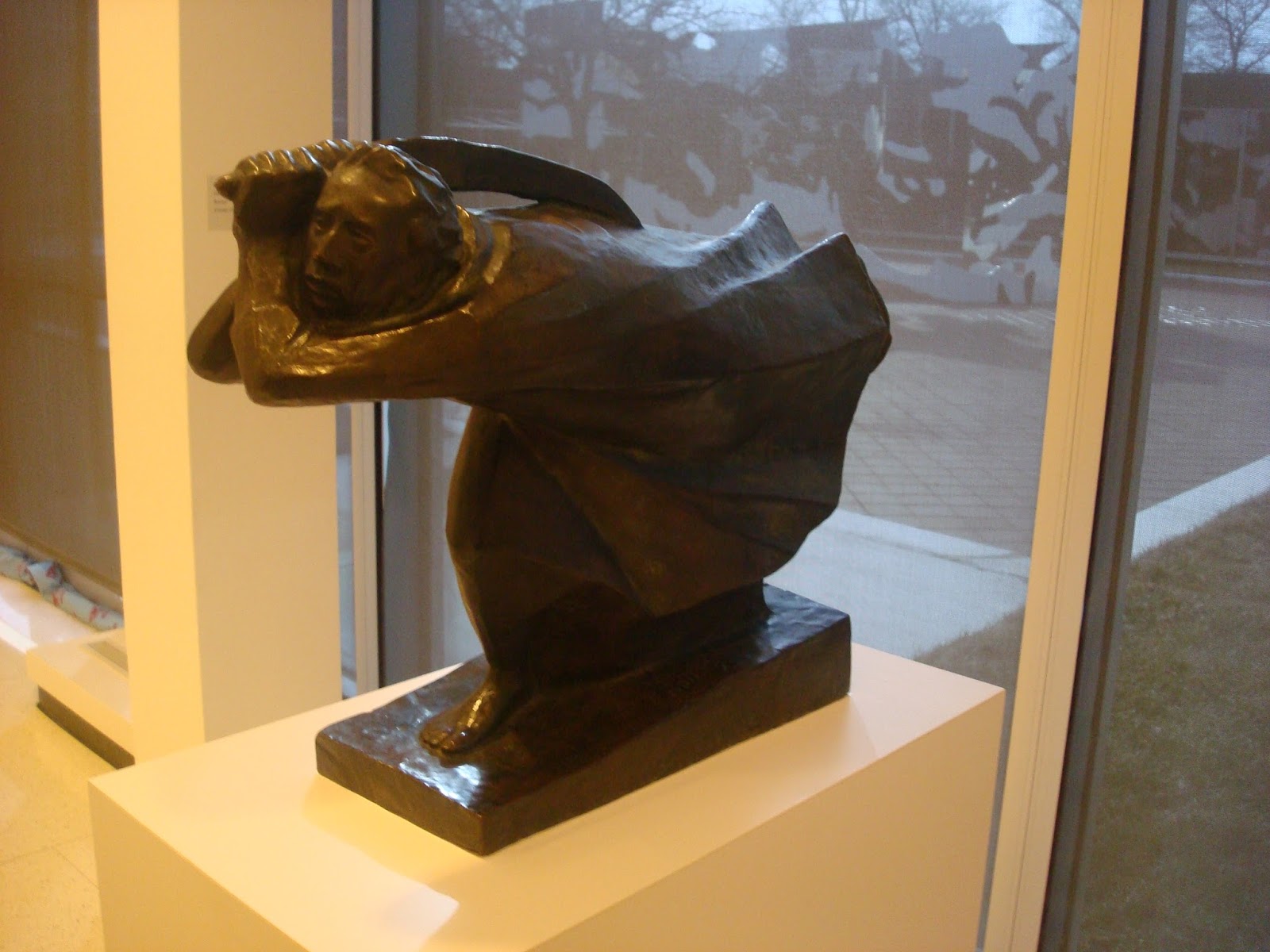
  • I would also like to know what inspired the artist, Der Racher, of The Avenger, 1914.  I really liked the metal used in this sculpture but would like to know more about the story behind it.  


Sunday, February 21, 2016

1. Discuss what you thought about creating the Value Scale and Color Wheel.
I thought creating the color wheel and value scale were quite easy.  However, I definitely struggled creating the value scale a lot more.  I never realized how has it is to create such a scale using pencil.  In my picture my last three are barely visible but I think I struggled with going lighter the most.  
2. Which media did you enjoy working with the best and why?
I enjoy using paint just because I think it's more fun than the pencil/charcoal.  Also, I just love working with colors better.  
3. What was the most important discovery in the creation of these studies?
I think I discovered what media I enjoyed working with more and also the difficulties of both.  Creating value was something I thought would be extremely easy but turned out to be a lot more concentration than I thought.  
4. What is the most important information you learned from watching the videos for this project? What is your opinion of the videos?
I think the most important information I took away from this project is that red, blue and yellow aren't the primary colors.  It was confusing to hear after all these years of art learning it that way.  I thought the videos were very helpful in showing us how to construct both pieces.